No products in the cart.

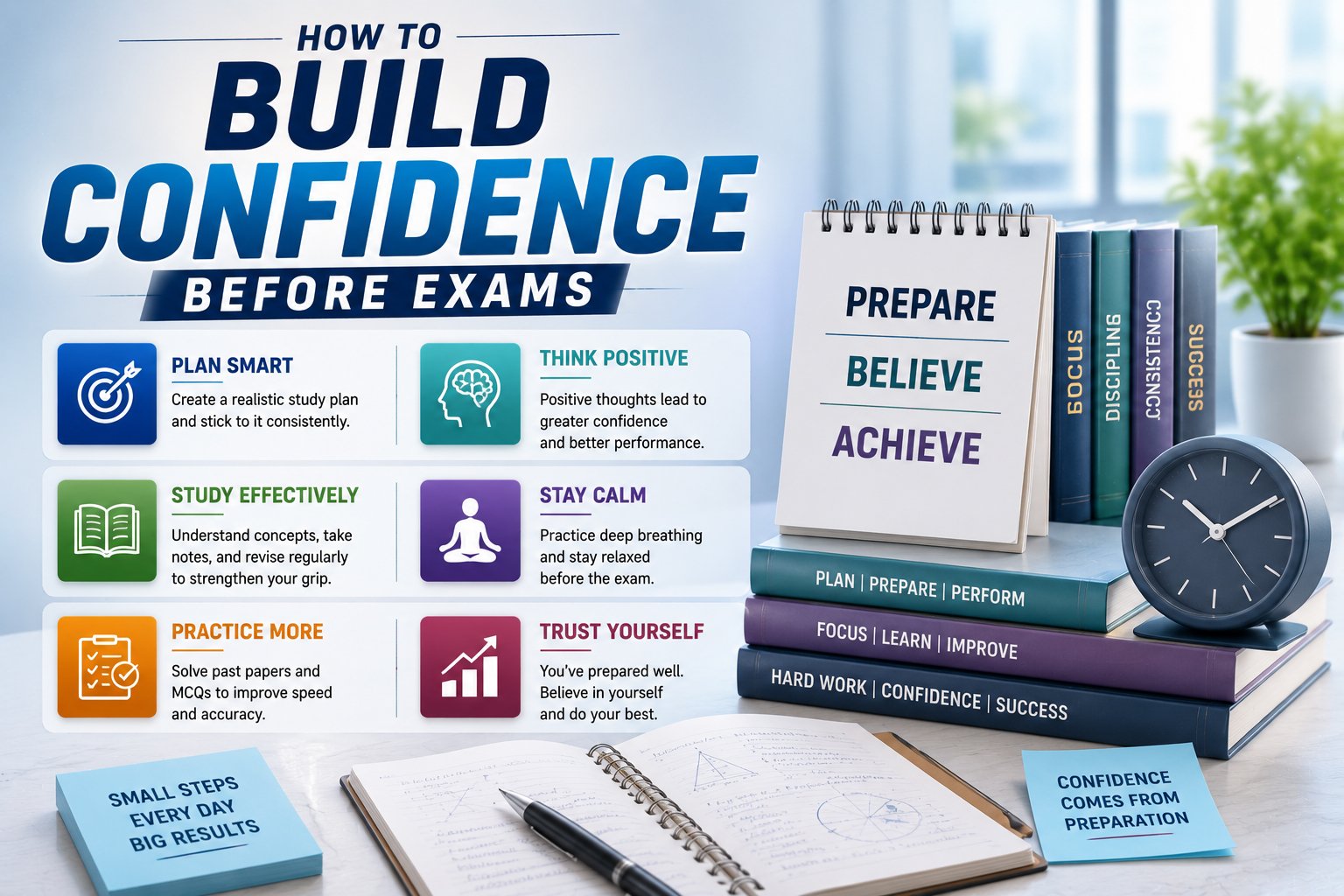
Build confidence before exams by preparing consistently, practicing regularly, and maintaining a positive mindset. Many students know their subjects well. However, they still feel nervous when exams approach. As a result, concentration, memory, and performance may suffer.
Fortunately, confidence is not something people are born with. Instead, it is a skill that develops through preparation and good study habits.
In this guide, you will learn practical ways to build confidence before exams and perform at your best.
Confidence plays an important role in academic success.
Students who feel confident often:
Therefore, confidence allows students to use their knowledge more effectively during exams.
One of the best ways to increase confidence is to begin preparation early.
Students who start in advance usually:
As a result, exam day becomes much less stressful.
A study timetable provides structure and direction.
For example, students can:
Consequently, preparation becomes more organized and manageable.
Model papers are excellent confidence builders.
They help students:
Furthermore, regular practice reduces fear of the unknown. The more students practice, the more comfortable they feel before the real exam.
Many students lose confidence because they expect perfect results.
However, perfection is not necessary.
Instead, focus on:
In the long run, small improvements create significant success.
Revision strengthens memory and reduces uncertainty.
Students should revise:
Moreover, regular revision helps students build confidence before exams because information remains fresh in their minds.
Negative thinking often damages confidence.
Instead of saying:
❌ I will fail.
Try saying:
✅ I am improving every day.
Likewise, replace:
❌ I cannot do this.
With:
✅ I can succeed if I continue practicing.
Positive thoughts encourage better performance and motivation.
Every student has strengths and weaknesses.
Unfortunately, many students ignore difficult topics. As a result, their confidence decreases.
A better approach is to:
Consequently, students feel more prepared and capable.
Physical health affects mental confidence.
Students should:
In addition, healthy habits improve focus, memory, and energy levels.
Every student learns differently.
However, comparing yourself with classmates often creates unnecessary pressure.
Instead, focus on:
Over time, confidence grows when students measure success through personal improvement.
The way students talk to themselves matters.
Try repeating statements such as:
As a result, positive self-talk gradually strengthens confidence.
Al-Razi Publications provides student-friendly educational resources designed to support effective learning and exam preparation.
Students can use:
These resources help students:
Therefore, better preparation helps students naturally build confidence before exams.
Late preparation increases stress and uncertainty.
Without revision, students may forget important information.
Students should recognize strengths as well as weaknesses.
Comparison often reduces confidence and motivation.
Negative thoughts can weaken performance and increase anxiety.
Students who feel confident often enjoy:
Most importantly, confidence helps students demonstrate their true abilities.
First, remember that confidence does not appear overnight. Instead, it develops through consistent effort and smart preparation.
Moreover, regular revision strengthens memory and improves understanding. In addition, solving model papers increases familiarity with exam patterns. As a result, students feel more comfortable and prepared.
However, preparation alone is not enough. Students should also maintain healthy habits and positive thinking. Finally, trust your efforts and stay focused on your goals.
Overall, students who prepare consistently, revise regularly, and practice effectively are far more likely to succeed in examinations.
This version uses substantially more transition words and removes repeated sentence starts, which should resolve the two remaining Yoast readability warnings.