No products in the cart.

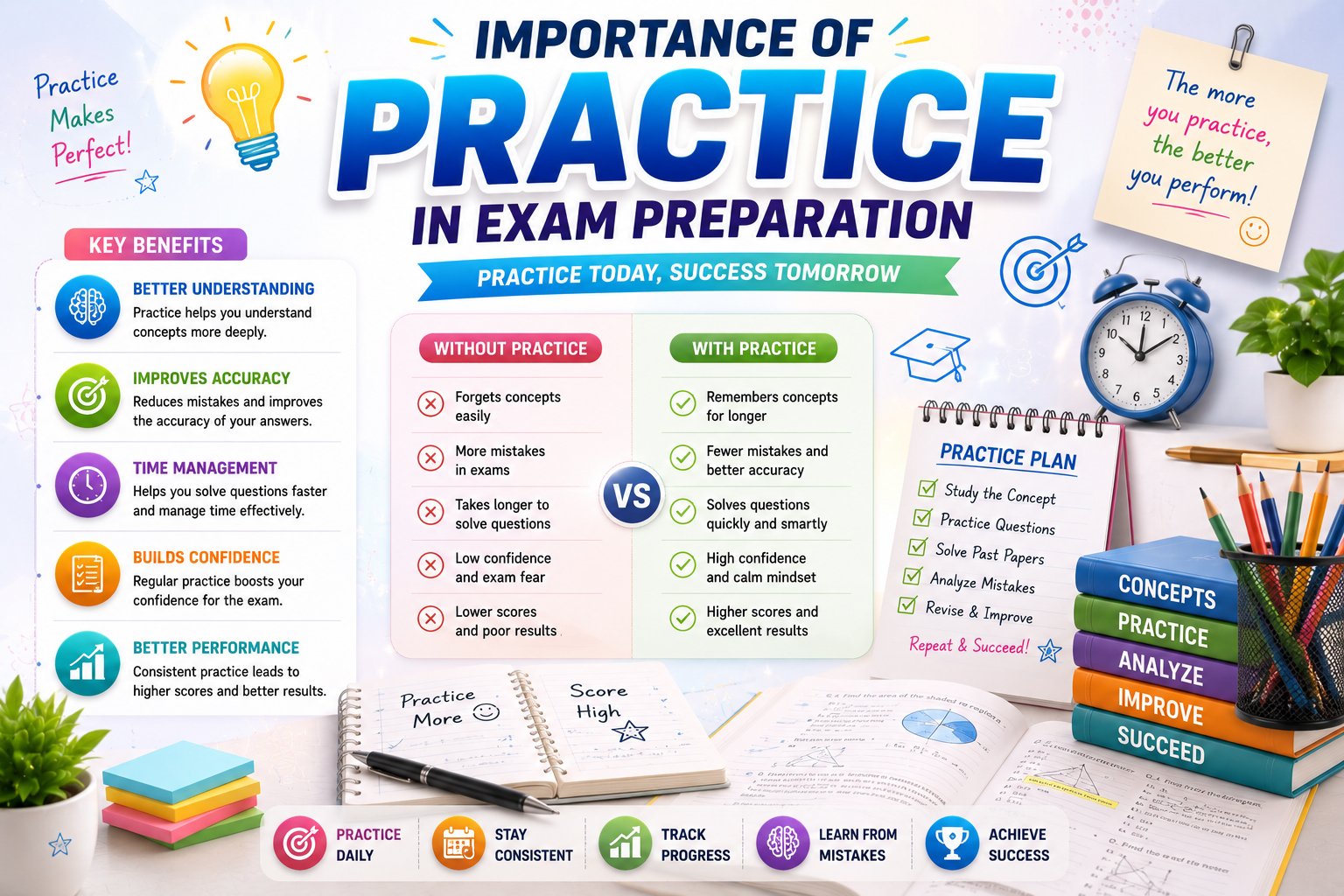
Practice exam preparation is one of the most important factors in academic success. Many students spend hours reading textbooks and notes but still struggle during exams because they do not practice enough.
Studying helps students learn concepts, but practice helps them apply what they have learned. Students who regularly practice questions, exercises, and model papers usually perform better in examinations and feel more confident on exam day.
In this blog, we will explore why practice is essential for exam success and how students can use it effectively.
Learning a concept is only the first step.
To truly master a subject, students must:
Practice transforms knowledge into skill.
One of the biggest benefits of practice is better memory retention.
When students repeatedly solve questions:
Regular practice reduces forgetting and strengthens understanding.
Confidence comes from preparation.
Students who practice regularly:
The more students practice, the more confident they become.
Practice reveals mistakes that students may not notice while reading.
For example, students may discover:
Finding weaknesses early allows students to improve before exams.
Many students know the answers but fail to complete papers on time.
Regular practice helps students:
This is especially important during board examinations.
Students should use different forms of practice during exam preparation.
Textbook exercises strengthen basic understanding.
Students should complete:
This builds strong subject foundations.
Model papers help students:
They are excellent tools for exam preparation.
Past papers show:
They help students focus on relevant material.
Many students read answers but never write them.
Writing practice improves:
This can significantly improve exam performance.
Consistency is more important than intensity.
A good routine includes:
Regular practice produces better results than last-minute cramming.
Time management is a major challenge during exams.
Practice teaches students:
Students who practice under timed conditions usually perform better during real exams.
Fear often comes from uncertainty.
Students who practice regularly:
This naturally reduces stress and exam anxiety.
Different subjects require different practice methods.
Practice:
Daily practice is essential.
Practice:
Practice:
Practice:
Al-Razi Publications provides educational resources that help students practice effectively.
Students can use:
These resources help students:
Students should avoid:
Regular practice is far more effective.
Every mistake is an opportunity to learn.
Understanding and application are both important.
Weak areas need extra attention.
Timed practice improves exam performance.
Students who practice consistently enjoy:
Practice turns preparation into results.
The practice exam preparation approach is one of the most effective ways to achieve academic success. Reading and studying are important, but they must be supported by regular practice.
Students who:
usually perform better in exams and feel more confident.
Success is not only about how much you study.